
Local Awareness
On Local Knowledge Theory, Situational Awareness, Compute Pricing and overlapping questions.

Aschenbrenner’s Situational Awareness’s performance over the past couple of years is an impressive feat. No investor of our generation has been able to transform a few hundreds of millions in more than $13B so quickly. As his fund’s holdings grew two fold since the beginning of the year, internet and institutional investors have started following his every step. Yet as his latest 13F came to be published, a few observers have marked that some of his latest selling transactions didn’t really matched his usual investment style and scenario. Could Leopold have lost the plot ? Can Hayek’s Local Knowledge Theory might discern if Situational Awareness will become the biggest fund of all time, or another Long Term Capital Management ?
Leopold Aschenbrenner and Situational Awareness
As many great Substack articles and twitter threads have been written about the young prodigy’s story, we’ll go over the essentials that will help us make a transition to the rest of our article.
After graduating with two degress at 19 from Columbia University, he enters the sensitive FTX Future Fund, in which he develops his first practical abilities and deploys his theoretical knowledge. As the FTX empire fell over night from fraudulent activities he finds a way in entering OpenAI in the Superalignment team, once one of the most important teams in AI, as they directed their efforts to answer crucial questions on how to escape the worst cases for AGI, which were still at the center of the debate when Elon Musk was at OpenAI.
In April 2024, as the young researcher shares his positions on the race to AGI, mostly about the current geopolitical scientific conflicts in the industry between the CCP and the West, he’s corrected by OpenAI’s Human Ressources team as potentially border-lining the company’s policies. The following is resuming the then situation:
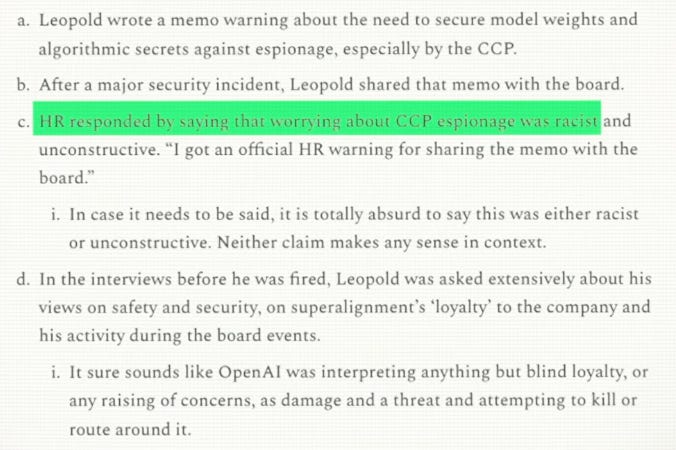
This event, as much special as it might have been, loaded the researcher with enough passion that he unveiled soon after his most important piece so far, which will give its name to his future investment fund, Situational Awareness. The more than 160 pages essay explores AI’s future orders of magnitudes, its meaning for work and research, and the ways we could achieve and maintain it without overwhelming us with risks. Of the vectors that would allow us to attain AGI, three are highlighted.
Compute Power
Algorithmic Efficiency
Unhobbling
Yet the AI race doesn’t only depend on scientific genius, but first and foremost on industrial infrastructure, which is the main topic and conclusion of his essay. The strategy in itself revolves around the companies that build, at their core the non reproductible assets.
Because as meant in his essay, Leopold imagines AI as completely opposite to that state. An army of AI researchers can work non stop eternally with the sole purpose of finding ways of increasing the number of agents that constitutes it. The only limit of models’ duplication is compute. That is why GPU prices rose tremendously, because the device in itself represents knowledge creation. As Venture Capitalist Tomasz Tunguz said in a recent post, “Frontier model releases correlate with demand shocks”.
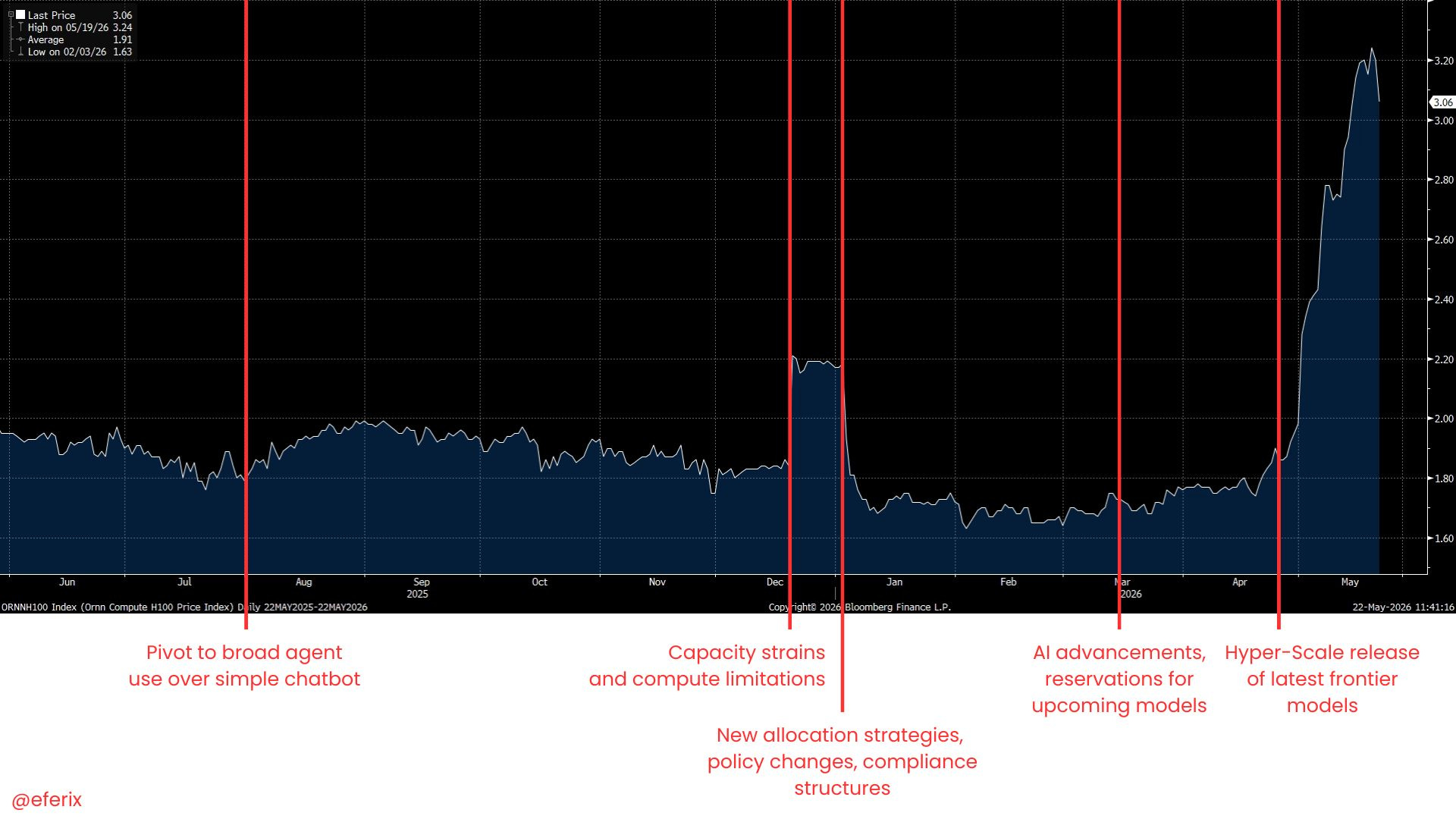
Compute Power’s pricing spikes are then another risk to which companies have to answer accordingly, with the possibility of treating it as other commodities. Which is why the american startup Ornn, recently partnered with the Intercontinental Exchange (ICE) in order to bring to markets its Ornn Compute Price Index (OCPI), a “transaction-based benchmark for GPU compute prices that tracks live-traded spot prices across major hardware types such as H100, H200, B200, B300, and others.” This and future indexes of the company are also available and becoming widely used on the Bloomberg Terminal. The following is a snapshot of latest compute power pricing surges and highlighting causes of their movements:
Pivot to Agents
First wave of AI agent workflows above simple use of chatbots, as was the norm up to that point. Developers’ access to a new era of AI use allowed companies first to proceed to the change, which is why, in a period of utmost compute development, prices rose lightly.
Capacity Constraints
To understand this move, we need to dig into how the index works. As still learning in the topic, the following is a more synthetic explanation demanded to Gemini : “When major tech companies and "neocloud" providers faced temporary friction getting new infrastructure installations or clusters online to handle the holiday traffic rush, buyers were forced onto the open spot market. Because the Ornn Index tracks actual completed transactions (not just advertised rate cards), it instantly registered this panic-buying spike before supply re-stabilized in January.”
Policy Changes
In order to handle the current changes in the industry following a certain framework that still had to be developed until then, new compliance structures went live, which allowed companies to rethink their compute use and the specific budgets that could be allocated to it.
Pre-Storm Developments
Compute demand maxed out internally, as AI labs and frontier developers prepared for the release of their newest models.
The Storm
The hyper-scale release of the following models, and the surge in compute pricing over the same period ; GPT-5.5 Family, Claude 4.7, 4.8 and Mythos Preview, Gemini 3.5 and Omni, Grok 4.3, DeepSee V4 Pro and Flash, Meta Muse Spark and others.
This not being the core of the article, recent movements have of course changed the current price of the index, with the release of Anthropic’s Fable and others among a new wave of the AI buildout. An interesting highlight to make is Leopold Aschenbrenner’s link to all of these releases.
It happens to be that Leopold’s own fiancée, Avital Balwit, is Chief of Staff at Anthropic, and that many of his fellow researcher friends or closer colleagues, have or still occupy positions in global AI labs. This is personal matters and deserves only then to be highlighted, but its understanding of the industry and his own Local Knowledge as will be explained in the following, are certainly strengthened by these happenings.
Concerning the investment fund’s recent actions though, as it has been many times underlined over twitter and other social media alike, his recent 13F filing for the first quarter of 2026 indicated a slight change in its strategy. While the broader topic of the fund stays ground development of the industry, certain of his exists have sparked debate over his ability to still spot the right moments, investment wise, in which the fundamental value of the companies are worth divesting from. Of them can be counted Lumentum Holdings, Intel stock and options and Coherent among others, which would have, if the fund had not exited, brought nearly $2B of additional performance.
A couple of weeks ago, Situational Awareness filed a new position, one which has already made ink flow on the internet Nebius. Disclosed as its biggest ever bet, representing more than 20% of its entire fund and a 5.6% stake in the dutch neocloud, the company’s stock price rallies to this day, followed in that same period with the renewed trust of Nvidia and an 8 billion euros investment in France announced by president Macron himself. This as a proof of the same strategy, the one taking care of the picks and shovels instead of the AI models above. Since then, while having underperforming puts in big names, the fund still highlights a massive performance, coherent with the last two years’ explosive run.
Here then comes another small part of our post.
Hayek’s Local Knowledge Theory
While Walras defined the Market as perfect and nearly out of this world, Hayek brought forward arguments that are still echoing today. As a neoclassical economist, he described the Market as among us instead of superior to us. From this very foundation rose the Local Knowledge Theory. One interpretation of it is that crucial economic decision making and understanding can’t be made or thought by people external to the time and location in which it has taken place. In a certain sector, the financial knowledge required may be an additional problem to people external to the world to which that knowledge belong. He adds that the more the market would turn to be decentralized and competitive, the more that problem could be dealt with correctly.
Of course, it can also mean that whenever someone that had local access to that knowledge would unfortunately move out, he would face the same problem elsewhere while progressively losing his former insights.
The link to Situational Awareness and Leopold Aschenbrenner is pretty coherent. As an OpenAI researcher for a while, with still strong AI labs ties to this day, and most importantly a strong opinion statement over the future of the industry of which his entire fund depends, Local Knowledge is crucial to the well being of his theories and actions.
But as Hayek specified, among several sources of knowledge, as local is mostly personal, abilities can still be eroded over time if one stumble upon other topics on the way, distracting him of his main assumptions, this being of course opposite to evolution, which welcomes arrangements.
Wether Leopold’s recent actions, such as losing nearly 2 billion dollars of potential performance, or his current bets against Nvidia and alike, indicate the fund’s losing the plot is a question that requires more analysis, and mostly over a bigger amount of time. What differs from other funds is still his novelty for such a performing portfolio. Long Term Capital Management as well knew a tremendous rise in its positions over the first few years, we know what happened next though.
Really interesting article! I didn't realize he was still so ingrained within the AI industry. Thanks for sharing!