
Where • Value ?
Investors are diverging on where to make their money safe.

A few days ago, I saw a post on Substack saying “The stock market is the only store where its customers run out if there’s a sale.” This post will be about where they went.
Recent Events
As we’re now navigating through an interesting and important earnings season, decisive in the advancement of a growing economic activity amid unstable geopolitical relationships, market activity was predicted to be volatile. It did for a while, with notable moments such as this week’s tech crash, the possible death of the SaaS model in its current form, the crypto crash and the end of the week’s peak for the Dow Jones at $50,000. This is of course a lot of events to put into a single sentence. And yet, while the VIX and VVIX volatility levels peaked on Thursday, they decreased respectively by 18 and 12 percent on Friday, when the S&P and DJI rallied. Historically speaking, these haven’t happened a lot in history, and their probable next month levels are then predicted to be from 1.5 to 2% higher.
That doesn’t mean that both volatility indexes aren’t on the verge of fearful indicators and shouldn’t be monitored, but historically speaking, next month could see a clear gain.
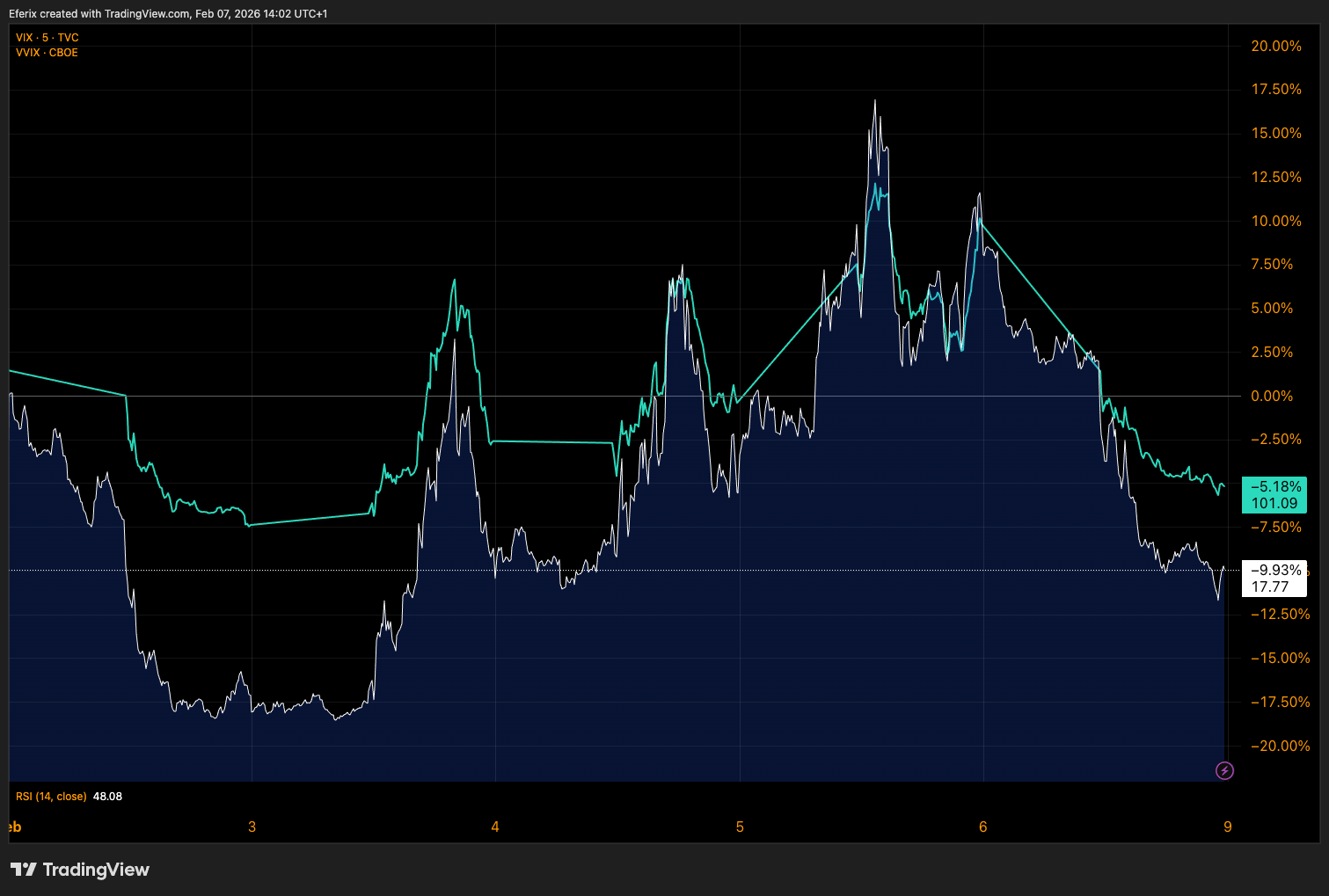
Market activity will certainly continue to surprise us, because of the birth of another type of AI race, the following months’ new reasoning models releases, the transformation of Software as a Service which has rapidly evolved in a single week — our respective portfolios are the proof of it — and the ongoing concerns of the first comments of the next Fed Chair, who has been pretty silent this week. One question then remained until Friday, when things tried to come back to normal, yet don’t mean it will next Monday.
Where do investors go ?
Fixed Income
In a time where money flows are feared, fixed income presents itself as a secure investment solution.
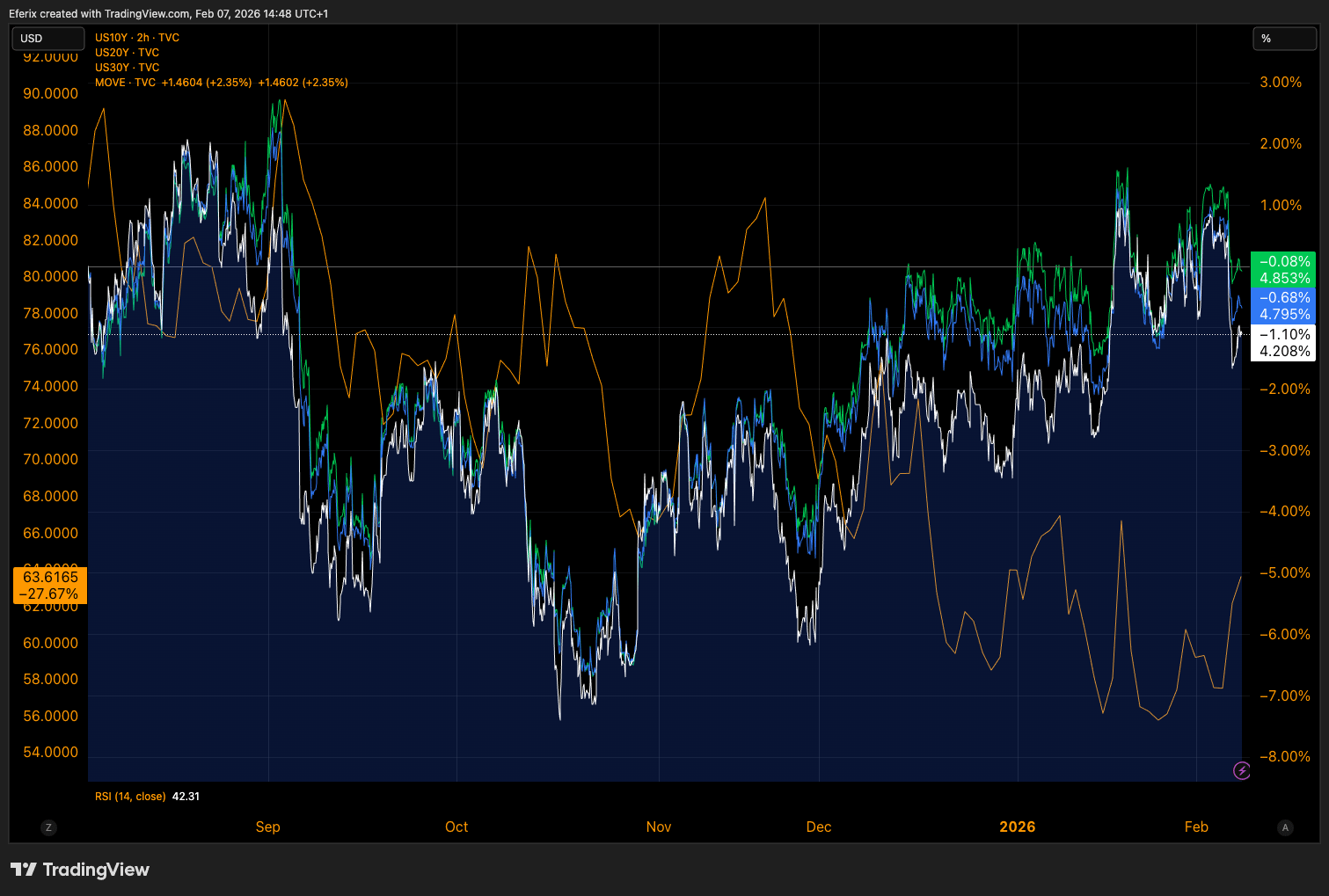
Treasuries have been pretty active this week, and while their yields surged just after the weekend, Thursday’s crash changed their course and finished the day from 1.6 to 2.7% lower. In that position, treasuries came back to their September levels. That does mean that even if they’re volatility has risen in the past week, it is still far considerably less than their April and May numbers, where the MOVE index was around 140.
That index slows down and decreases, indicating a slowing in the activity of option trading in the bond market in a medium term, even though some days can observe certain spikes. The curb could potentially be coming back to former higher levels if the amount of money poured into it came to explode, as for example a renewal in confidence level in the government or another unwanted terrible crash in the stock market.
While investors tended to have a rising attraction to riskier corporate bonds at the end of January, the nomination of the next Fed Chair and the ongoing concerns about general market movements make that money has been piling up in Investment Grade Corporate Bonds and more risk averse positions, as a growing LQD (iShares IG Corporate Bonds of companies like Apple, Amazon, Microsoft, … ) and a decreasing HYG (iShares High Yield “Junk” Bonds) indicate. It is still to be monitored on the short term, as the credit spread between both has tightened this week on a regular basis.
Thursday’s crash levels having continued at the end of the week, a conclusion would have been taken as one of risk averse positioning from the markets. And yet, as DJI and other major indexes have rallied on Friday, market movements like these can’t be used as proof of that conclusion, and a few more days would define whether the market lost its mind or jumped on the occasion to benefit the dip buyers.
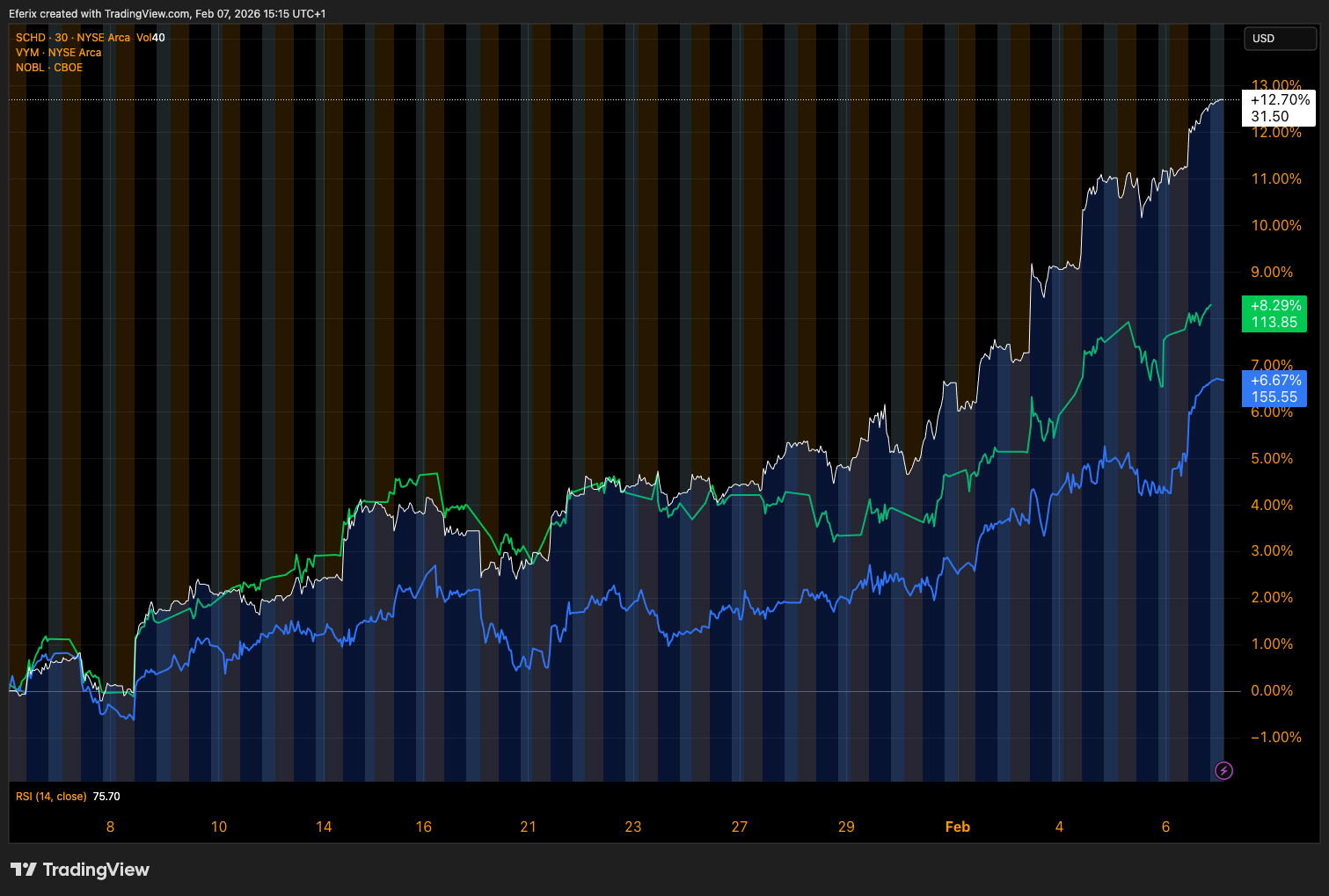
As The Macro & Equity Pulse and I conversed about on a precedent note, Dividend ETFs can be seen as a form of or alternative to fixed income for a while now, considering they’re analysed as long term interest paying machines. Since Liberation Day, where they crashed like any other stock, inflows in Dividend ETFs have soared in the past year and year to date. Even more so can they be considered as a form of safe haven as their Thursday levels have had dramatically less damages than “regular” ETFs and indexes, even knowing a slight increase at the end of the day and continued their advancement in post-market and on Friday. SCHD (Schwab US Dividend Equity ETF), VYM (Vanguard High Dividend Yield Index ETF) and NOBL (ProShares S&P 500 Dividend Aristocrats ETF) have all rallied since the beginning of the year, ranging their gains from 6.7 (I’m sorry) to 12.7%.
Secure Sectors
As the entire investment world ran away from tech names at the end of the week, as well as from too optimistic companies like Amazon, some sectors gained attention and inflows, branded then as secure placements when the rest of the market was on fire.
One of them can be even more so be represented as secure since the beginning of the month; infrastructure. The CBOE listed IFRA (iShares US Infrastructure ETF) and PAVE (Global X U.S. Infrastructure Development ETF), which holds companies ranging from electricity providers in Hawaï to Gas suppliers in New Jersey have surged in February. Placing money into constant utilities and immuable necessities are a way for investors to bet against trendy movements in order to protect their money in case if everything else disappeared and we had to stick to basics.
That doesn’t mean that only tech stocks have been experiencing considerable drawdowns this Thursday, really showing that what we experienced was a light crash.
Metals
After being considered safe havens for a really long time last year, Silver and Gold have been experiencing booms and bursts in the past month on a regular basis. While the volatility of the latter is progressively slowing down, Silver is now continuing its free fall and rallies at a much faster pace. The recent news of a Chinese magnate taking a $300m short position against the metal has been criticised all over the internet or seen as one of the strong arguments against a rally that lost its way. Of both, only Gold sticks to its precedent bull scenario for now, as I talked about in my first ever Substack post. Concerning Silver, things are falling apart, with magnates shorting the metal at incommensurable levels, and also friends of mine personally going against it. If this behaviour spreads, both metals will certainly oscillate between levels without breaking ATHs at their former pace. This means that of the three characteristics to pay attention to, the ones that will certainly make this rally stop, two are already happening. If you haven’t read my first ever post, here are the three main things we should look at when Gold and Silver rally.
The Fed stops cutting rates
Solidification of the dollar
Stopping from breaking ATHs
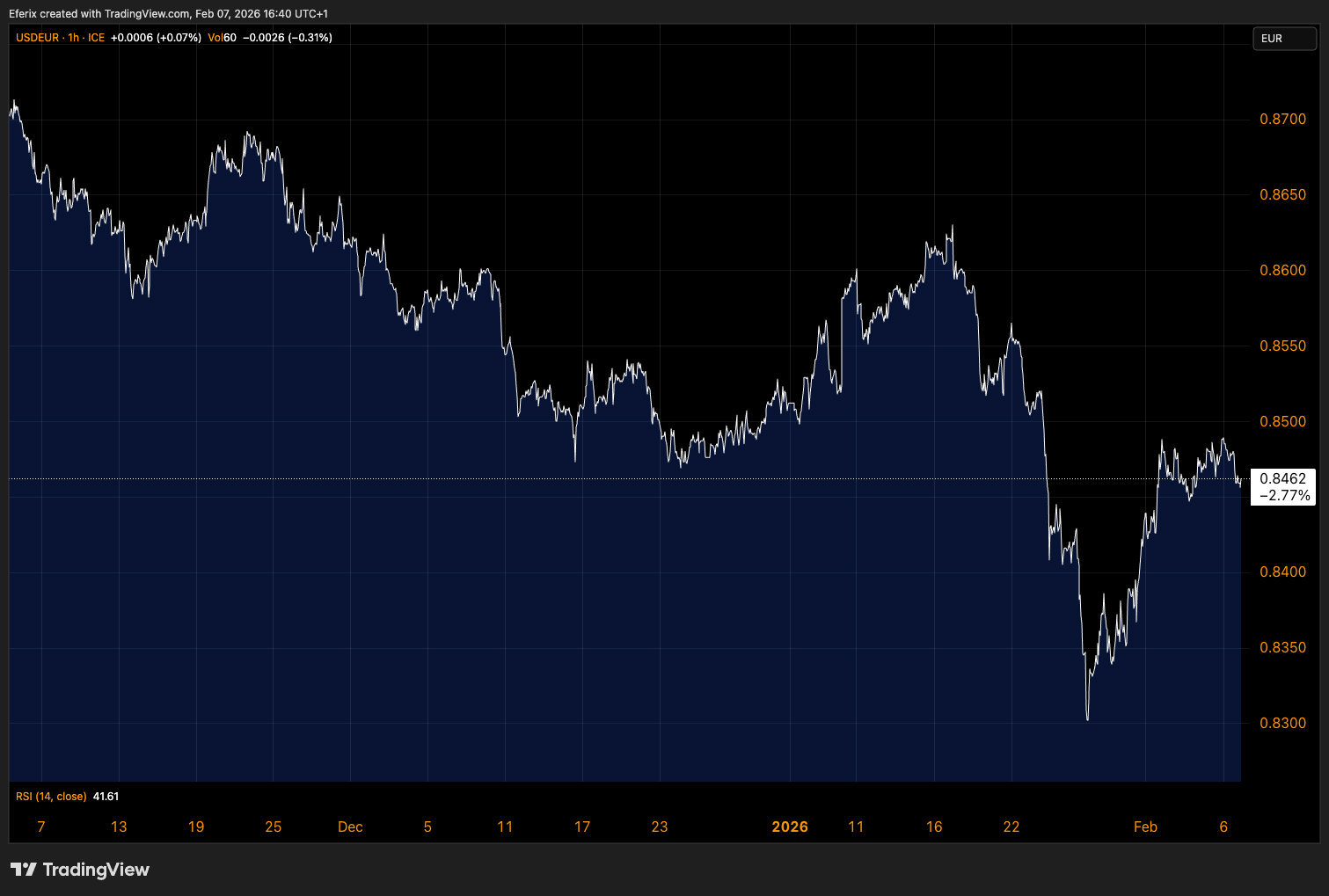
For now, the constant decrease of the dollar against other currencies is still a strong point in the scenario of the continuation of the rally. But as I said, it has to be monitored very carefully, and especially with the nomination and future first statements of the next Fed Chair.
Now what ?
This isn’t going to be a long conclusion.
Now, we wait and see.
Great article as always!
A few thoughts on the topic. The main theme this year is diversification. Anyone who has read the major banks' annual outlooks for 2026 will see that they are looking for ways to diversify their portfolios and reduce their exposure to AI. Real assets such as metals or real estate also offer protection against inflation. Regarding Warshs appointment the yield curve is pricing in dovishness, so I don't think the hawk's prediction will come true. This is not necessarily a positive development, as interest rate cuts for the wrong reasons can be detrimental to equities.
I was lucky to get out of a nice amount of my silver position I picked up years ago around 20$ two days before the crash. I read about silver price suppression. Why it is one of the only assets not to rise in the last 30 years when adjusted for inflation. Up until the recent run of course.